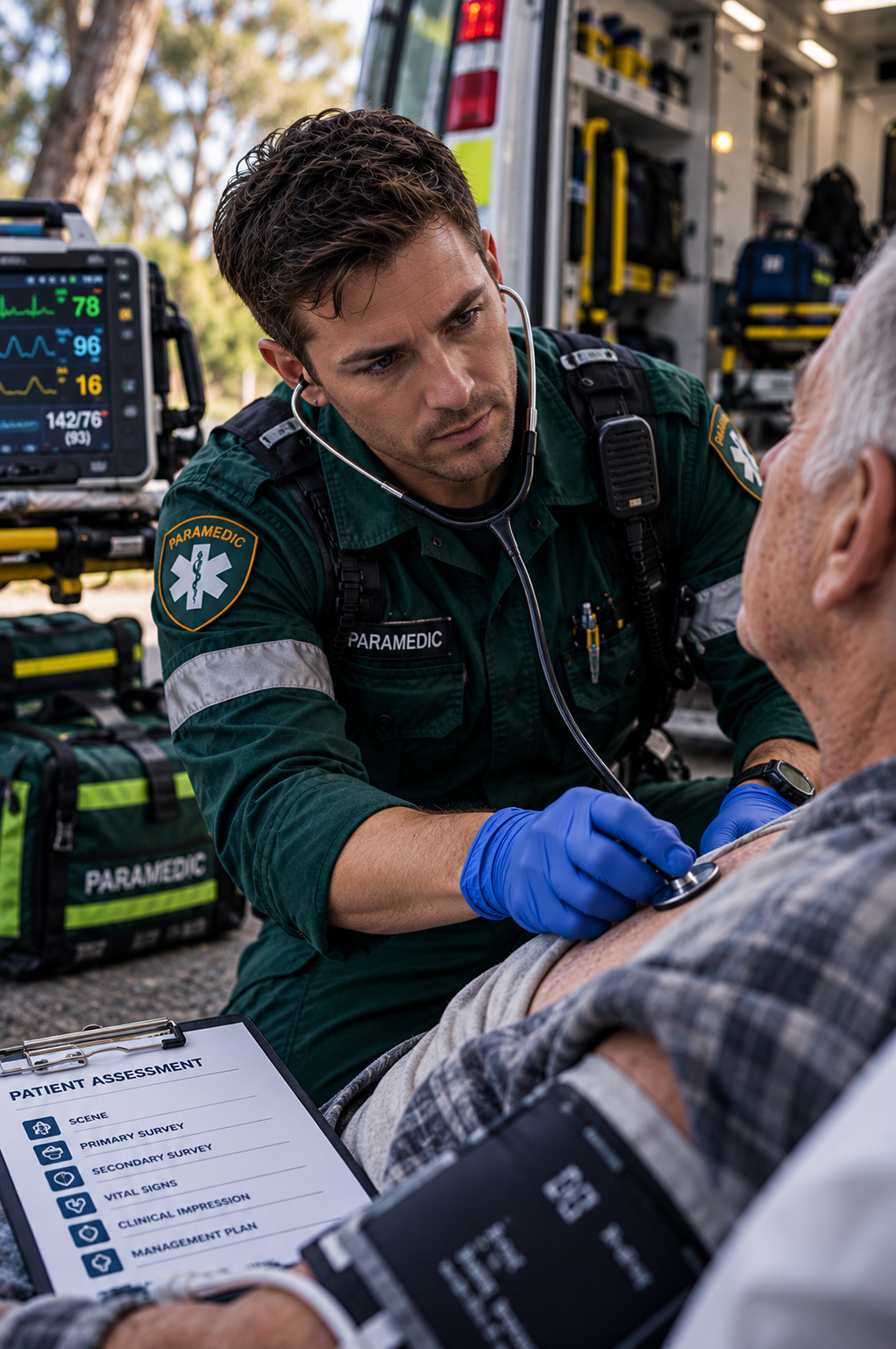
The Comprehensive patient assessment programme develops paramedics beyond protocol-driven primary and secondary assessment toward a more comprehensive model of clinical examination and diagnostic reasoning.
The programme incorporates assessment principles commonly used across emergency medicine and emergency nursing, including: observation; history; systems review; physical examination; clinical measurement; differential diagnosis; risk assessment and reassessment with particular emphasis on their application in the pre-hospital environment.
Participants repeatedly progress from: "What did I find? "to "What does that finding mean?"
By completion, participants should be able to:
• Perform an effective initial visual assessment before physical contact.
• Rapidly identify immediate life threats.
• Distinguish resuscitation assessment from comprehensive diagnostic assessment.
•Obtain a structured but conversational clinical history.
• Explore a presenting complaint systematically.
• Perform an appropriate review of systems.
• Obtain relevant past medical, medication, functional and social history.
• Identify important positive and negative findings.
• Perform a structured general examination.
•Assess mental status and cognition.
•Undertake focused cardiovascular examination.
• Undertake focused respiratory examination.
• Undertake focused abdominal examination.
• Undertake focused neurological examination.
•Undertake focused peripheral vascular and musculoskeletal examination where indicated.
• Perform relevant skin and hydration assessment.
• Integrate clinical observations with examination findings.
• Understand the strengths and limitations of monitoring equipment.
• Generate an appropriate problem list.
• Develop a clinically meaningful differential diagnosis.
• Identify dangerous diagnoses that cannot safely be missed.
• Use pertinent negative findings to refine clinical reasoning.
• Recognise inconsistencies between history, observations and examination.
• Reassess patients following intervention or changes in condition.
• Communicate assessment findings using clinically meaningful terminology.
• Produce a concise clinical synthesis and handover.
Paramedics and other pre-hospital clinicians.
Interactive lectures, workshops, case studies, group discussions and clinical simulations.
Beyond ABCDE: Becoming a clinical investigator
First impressions & the general examination
Clinical history taking
Cardiovascular & respiratory examination1
Abdominal examination
Neurological examination
Peripheral, skin & functional assessment
From findings to differential diagnosis
Clinical examination workshops
Integrated patient assessment simulations