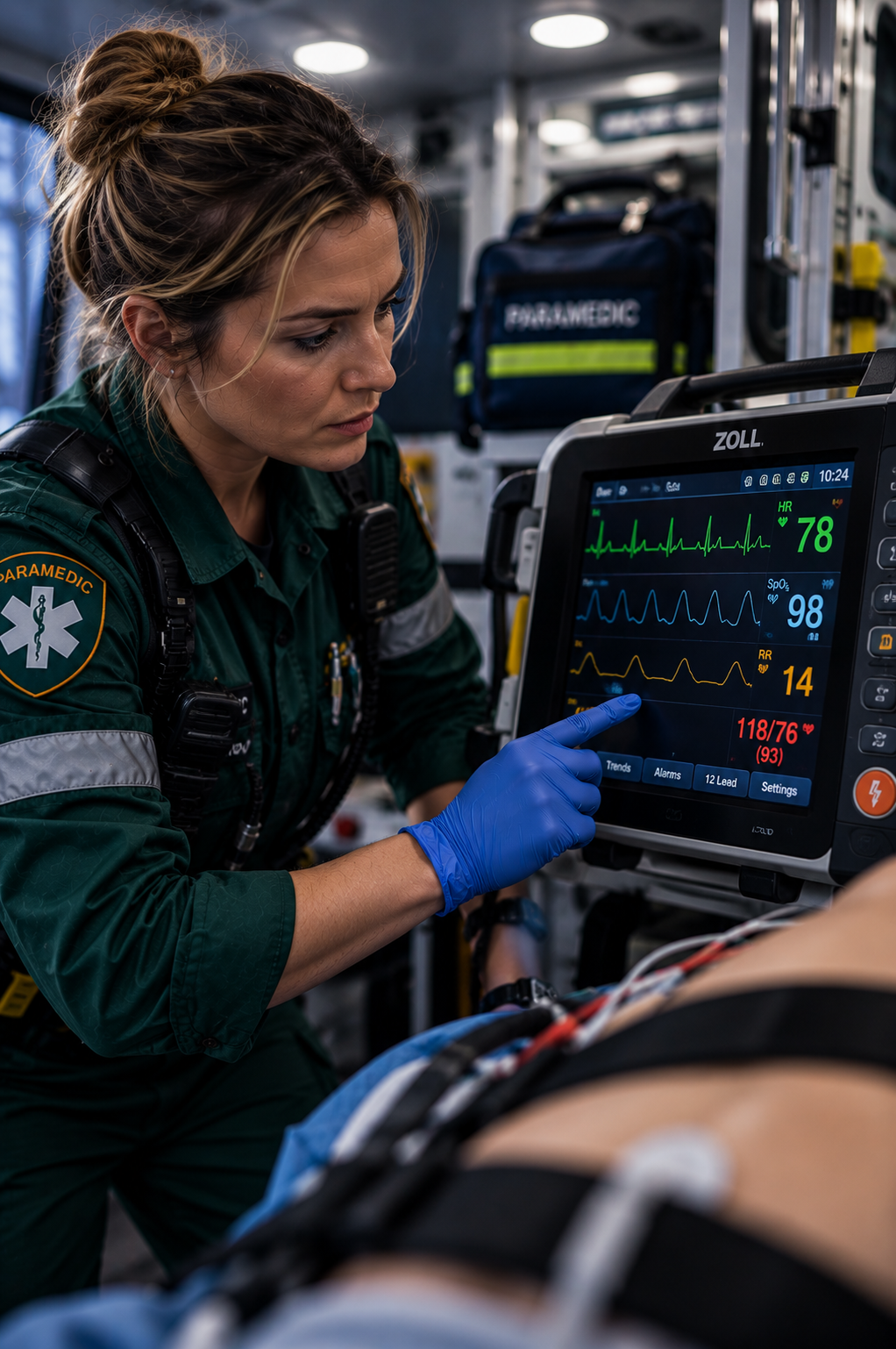
The ECG rhythm interpretation programme develops a systematic and clinically relevant approach to recognising and interpreting common and important cardiac rhythms encountered in emergency, pre-hospital and acute healthcare environments.
Participants develop an understanding of the electrical mechanisms producing ECG rhythms before progressing through structured rhythm analysis, normal rhythms, bradyarrhythmias, AV blocks, supraventricular tachyarrhythmias, ventricular rhythms and cardiac-arrest rhythms.
Throughout the programme, rhythm recognition is integrated with patient presentation, haemodynamic consequence and clinical decision-making.
By completion, participants should be able to:
• Explain the basic electrical conduction system of the heart.
• Relate cardiac depolarisation and repolarisation to the ECG waveform.
• Identify the P wave, PR interval, QRS complex and T wave.
• Understand standard ECG monitoring calibration and basic measurements.
• Calculate cardiac rate using several practical methods.
• Determine whether a rhythm is regular or irregular.
• Identify the presence, morphology and relationship of P waves.
• Assess the PR interval.
• Assess QRS width and morphology.
• Apply a consistent systematic rhythm-analysis method.
• Recognise normal sinus rhythm.
• Recognise sinus bradycardia and sinus tachycardia.
• Recognise sinus arrhythmia.
• Identify atrial ectopic activity.
• Recognise atrial fibrillation.
• Recognise atrial flutter.
• Recognise supraventricular tachycardia.
• Identify ventricular ectopic activity.
• Recognise ventricular tachycardia.
• Recognise polymorphic VT and torsades de pointes.
• Recognise ventricular fibrillation.
• Recognise asystole.
• Understand the concept of pulseless electrical activity.
• Recognise first-degree AV block.
• Differentiate second-degree AV block Mobitz I and Mobitz II.
• Recognise 2:1 and high-grade AV block.
• Recognise complete/third-degree AV block.
• Identify basic paced rhythms.
• Differentiate ECG artefact from genuine dysrhythmia.
• Integrate ECG findings with the patient's clinical presentation.
• Recognise ECG rhythms requiring urgent escalation or intervention.
Paramedics, nurses, healthcare students and clinicians who monitor, assess or manage patients with cardiac dysrhythmias.
Interactive lectures, case studies and group discussions.
From electricity to ECG
How to read a rhythm strip
Sinus rhythms & ectopics
Bradycardias & AV blocks
Narrow-complex tachycardias
Ventricular rhythms & broad-complex tachycardia
Cardiac arrest rhythms