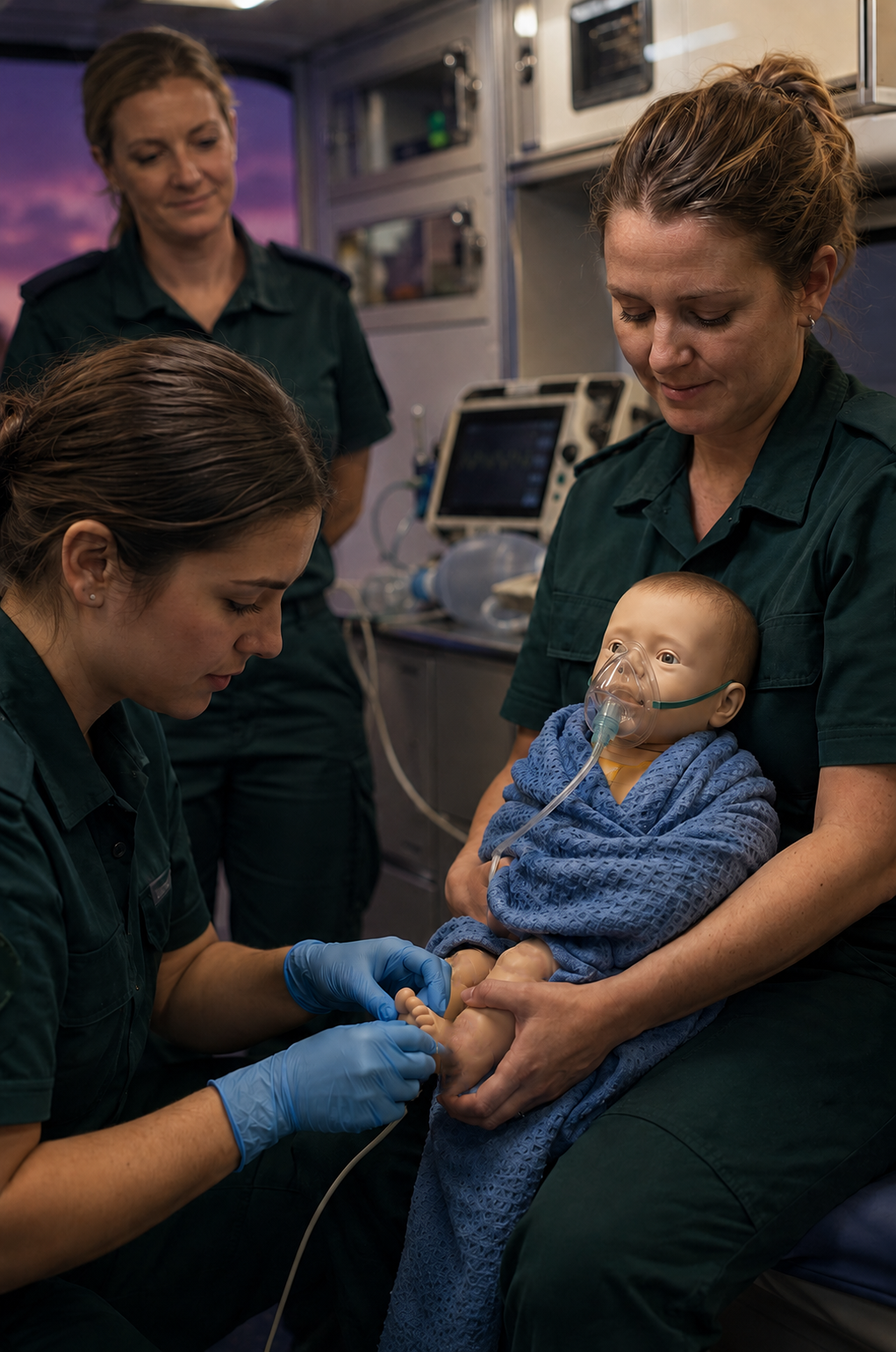
Paediatric emergencies are relatively uncommon for many clinicians. The critically unwell child is rarer still.Consequently, clinicians can experience uncertainty, heightened cognitive load and anxiety precisely when early recognition and decisive intervention matter most.
The EDOCEO programme therefore teaches participants to answer five questions:
- Is this child sick?
- What is making them sick?
- What physiological system is failing?
- What does this child need from me now?
- What am I going to do if they get worse?
The programme develops clinical judgement alongside technical capability.
The EDOCEO Academy Pre-Hospital Paediatric Emergency Care Programme builds upon the clinical knowledge and assessment framework of the Pediatric Education for Prehospital Professionals (PEPP) programme, while expanding this through the EDOCEO Academy emphasis on clinical decision-making, human factors, practical skills and realistic pre-hospital simulation. Participants who successfully complete the required PEPP pre-course and post-course assessments may be eligible to receive PEPP certification in accordance with current PEPP course requirements. Clinicians wishing to assist with the delivery or facilitation of future EDOCEO Academy paediatric courses will be required to hold current PEPP certification.
By completion, participants should be able to:
• Rapidly distinguish the well, unwell and critically unwell child;
• Apply a structured paediatric assessment without becoming dependent upon equipment;
• Understand age-dependent differences in paediatric anatomy, physiology and vital signs;
• Recognise respiratory distress, respiratory failure, compensated shock and decompensated shock;
• Manage common and immediately life-threatening paediatric respiratory emergencies;
• Provide effective oxygenation and ventilation to infants and children;
• Recognise and manage paediatric shock according to likely underlying physiology;
• Assess and manage paediatric trauma;
• Recognise neurological deterioration, seizures and altered consciousness;
• Manage important medical, toxicological, infectious, behavioural, endocrine and environmental emergencies;
• Recognise and manage bradyarrhythmias and tachyarrhythmias;
• Perform high-quality paediatric basic and advanced life support appropriate to clinical scope;
• Safely calculate weight-dependent equipment, fluids, energy and medication requirements;
• Use cognitive aids effectively without allowing them to replace clinical assessment;
• Manage children with complex and special healthcare needs;
• Manage uncomplicated childbirth, assessment and resuscitation of the newborn;
• Communicate effectively with infants, children, adolescents and their caregivers;
• Recognise indicators of possible child maltreatment and understand professional responsibilities;
• Understand how fear, stress, fixation and cognitive overload influence paediatric emergency care;
• Use parents and caregivers appropriately as clinical resources and members of the care team; and
• Make appropriate transport, destination and escalation decisions. Integrate assessment, clinical reasoning, procedural skills and human factors during realistic paediatric simulations.
Paramedics, emergency nurses, retrieval clinicians, critical care transport clinicians and other healthcare professionals providing emergency care to infants and children.
Interactive lectures, workshops, case studies and simulations.
Children are different — But don't panic
Paediatric assessment & recognition of the sick child
Airway, breathing & respiratory emergencies
Paediatric airway & ventilation skills
Shock & circulatory failure
Paediatric trauma
Neurological emergencies & seizures
Paediatric resuscitation
Cardiac emergencies
Medical Emergencies
Toxicology, endocrine & environmental emergencies
Childbirth & resuscitation of the newborn
Children With special healthcare needs
Child, family, behaviour & safeguarding
Human factors in paediatric emergencies
Medication, weight & the numbers problem
Clinical simulations