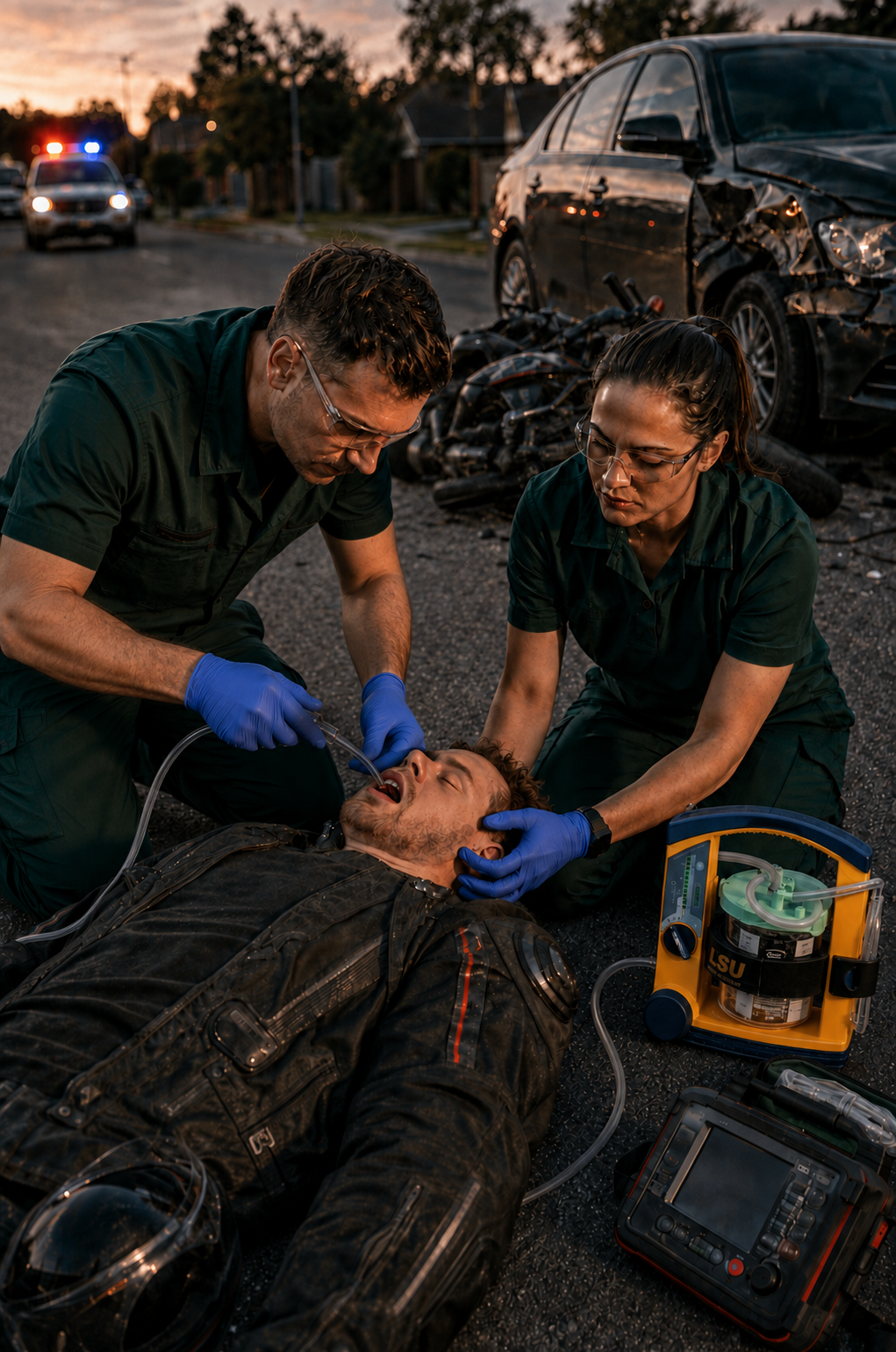
The Pre-hospital Airway and Ventilation (PAVE) develops clinicians capable of recognising airway and respiratory compromise, understanding the underlying physiological problem, selecting an appropriate management strategy, performing airway and ventilation interventions competently, and adapting that strategy as the patient's condition changes.
Through a blend of expert teaching, hands-on workshops and scenarios, case studies and group discussions, the programme aims to provide the skills required to manage patients’ airways and ensure adequate ventilation in emergency situations.
By completion, participants should be able to assess actual and potential airway compromise and distinguish problems of airway patency, airway protection, oxygenation and ventilation.
Participants should be able to formulate and communicate an airway strategy based upon patient physiology, pathology, anticipated difficulty, environment, available personnel, equipment, transport requirements and individual scope of practice.
They should demonstrate competence in basic airway manoeuvres, adjuncts, suction, bag-mask ventilation, supraglottic airway management and relevant advanced airway procedures.
Participants should additionally be able to:
• optimise preoxygenation and apnoeic oxygenation;
• recognise anatomically and physiologically difficult airways;
• manage heavily contaminated airways;
• use capnography appropriately;
• recognise ineffective ventilation;
• initiate and troubleshoot non-invasive ventilation;
• understand invasive mechanical ventilation principles;
• recognise and manage tracheostomy and laryngectomy emergencies;
• recognise a deteriorating or failed airway strategy;
• move appropriately between primary and rescue techniques;
• understand CICO and emergency front-of-neck airway principles appropriate to scope;
• recognise the haemodynamic consequences of positive-pressure ventilation;
• adapt ventilation for obstructive lung disease, TBI, cardiac arrest, ROSC and other critical illness;
• demonstrate effective airway leadership and followership;
• identify fixation error, task saturation and loss of situational awareness;
• use closed-loop communication and graded assertiveness;
• construct and communicate Plan A/B/C/D;
• recognise when not to escalate airway intervention; and
• integrate these skills during complex pre-hospital simulations.
Paramedics, emergency nurses, retrieval clinicians, pre-hospital physicians, critical care transport staff and advanced life support providers.
Interactive lectures, workshops, case studies, group discussions and clinical scenarios.
Airway management: More than a procedure
Airway assessment & clinical decision-making
Oxygenation, ventilation & respiratory physiology
Positioning, essential airways & bag-mask ventilation
Supraglottic airways
Suction & the contaminated airway
Tracheal intubation & advanced airway strategy
Failed airway & rescue strategies
Non-invasive ventilation
Invasive ventilation & post-airway management
Capnography & ventilation troubleshooting
Tracheostomy & laryngectomy emergencies
Human factors in airway emergencies
Special airway & ventilation situations
Integrated clinical simulations