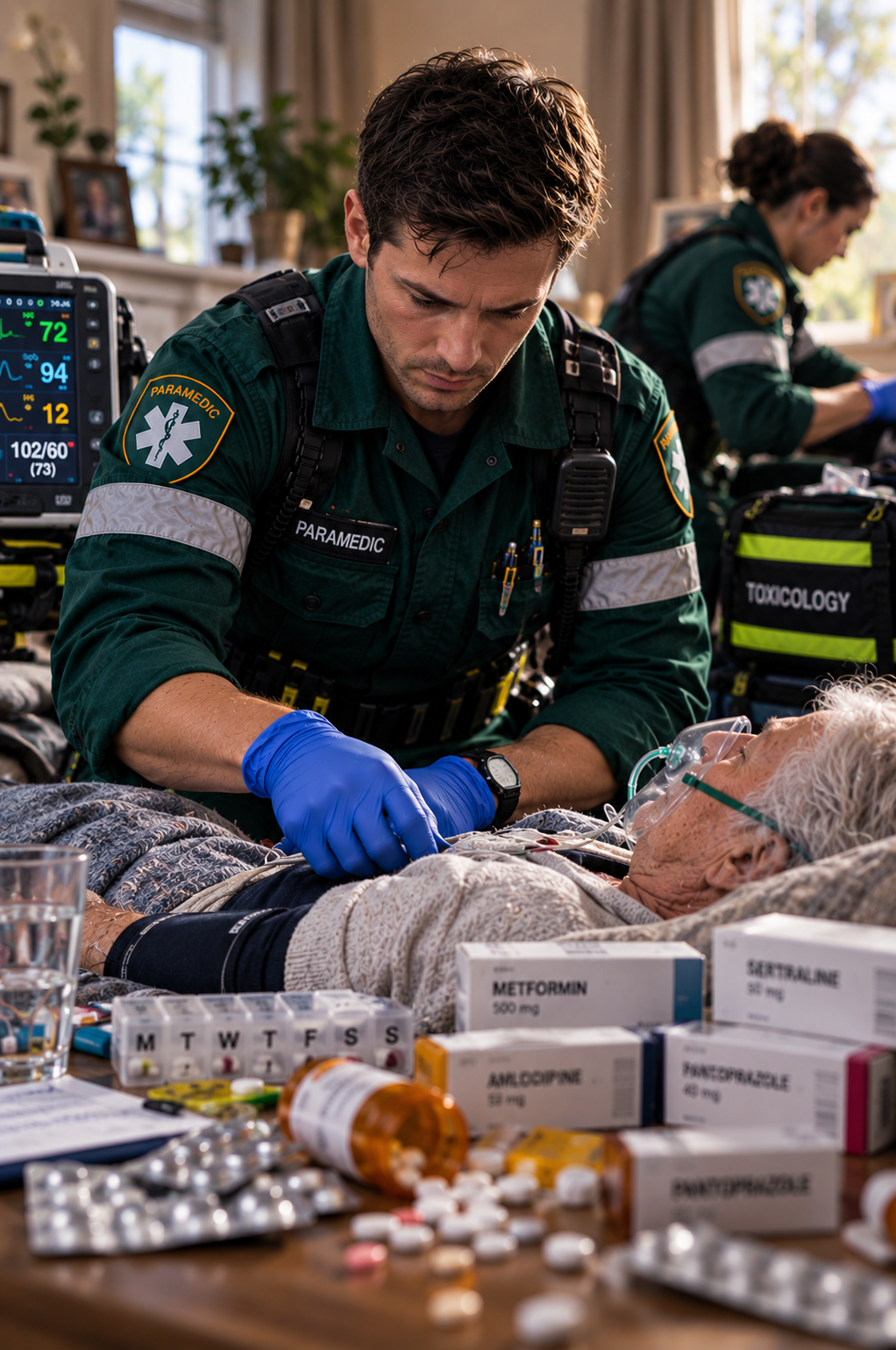
The Toxicology in pre-hospital care programme develops clinicians capable of systematically assessing and managing poisoning, overdose and envenoming in the pre-hospital environment.
It takes the Australian Toxicology Handbook's risk-based philosophy and translates it into the realities of paramedicine, including limited investigations; uncertain history; mixed overdoses; uncontrolled environments; evolving physiology; transport decisions; and finite resources.
The programme therefore integrates resuscitation, risk assessment, toxidrome recognition, ECG interpretation, supportive care, antidotes, envenomation and clinical reasoning.
By completion, participants should be able to:
• Perform a structured assessment of the poisoned patient.
• Identify immediate threats requiring resuscitation.
• Undertake a toxicological risk assessment from incomplete information.
• Establish likely agent, dose, route, timing and patient-specific risk factors.
• Recognise the importance of formulation and co-ingestants.
• Use environmental clues appropriately without anchoring upon them.
• Recognise common toxidromes.
• Distinguish sympathomimetic, anticholinergic, cholinergic, serotonergic, opioid and sedative presentations.
• Recognise toxicological causes of coma.
• Assess and manage toxicological seizures.
• Recognise and manage the agitated or delirious poisoned patient.
• Recognise toxicological hypotension and cardiovascular instability.
• Understand the importance of temperature in toxicology.
• Recognise important toxicological ECG abnormalities.
• Identify QRS widening and QT prolongation.
• Recognise sodium-channel blockade.
• Understand the principles and limitations of antidotal therapy.
• Manage opioid toxicity appropriately.
• Understand the toxicological uses of sodium bicarbonate, atropine, calcium, glucose and other relevant therapies.
• Recognise the limitations and risks of gastrointestinal decontamination.
• Manage common medication overdose presentations.
• Recognise the additional complexity of polypharmacy overdose.
• Assess paediatric, pregnant and older poisoned patients.
• Undertake appropriate assessment and first aid for Western Australian envenomation.
• Apply appropriate pressure immobilisation where indicated.
• Recognise systemic envenomation.
• Determine appropriate transport priority, destination and escalation.
• Communicate effectively with Poisons Information/toxicology services.
• Anticipate deterioration during transport. Integrate toxicological reasoning during simulations.
Paramedics, emergency nurses, retrieval clinicians and other healthcare professionals managing poisoned or envenomed patients.
Interactive lectures, workshops, case studies, group discussions and clinical scenarios.
The poisoned patient: Think differently
Toxicological risk assessment
Toxidromes: Recognising the pattern
The unconscious, agitated & seizing patient
Cardiovascular toxicology & the toxicology ECG1
Common & dangerous poisonings
Antidotes, decontamination & supportive care
Western Australian envenomation
Toxicology workshops
Integrated toxicology simulations