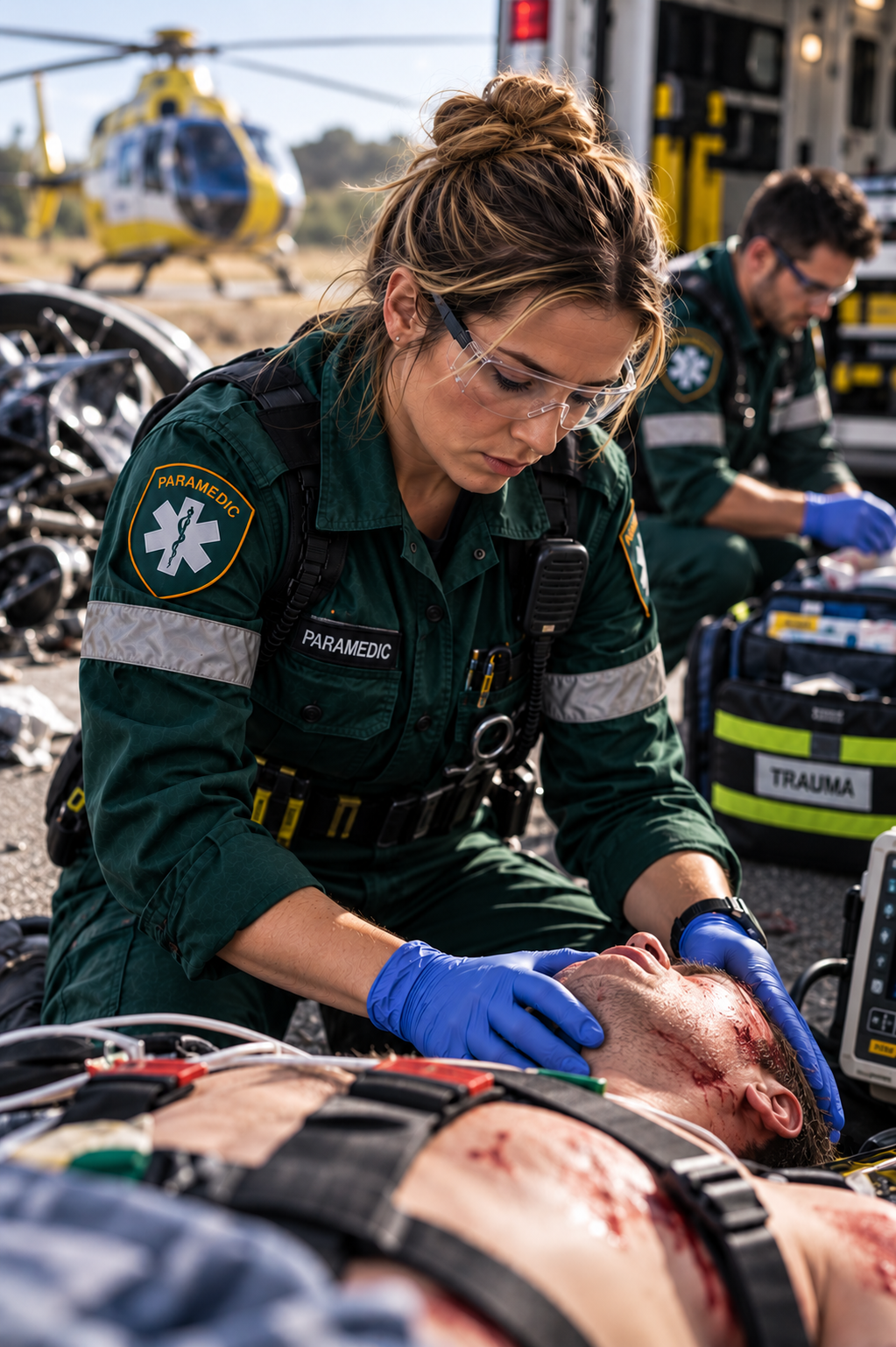
The Pre-hospital trauma assessment & management programme develops clinicians capable of systematically assessing, prioritising, resuscitating and transporting injured patients in pre-hospital environments.
Drawing upon established principles represented within trauma education, the programme extends beyond algorithmic trauma assessment through physiology; clinical reasoning; procedural skills; teamwork; human factors; environment; and reassessment.
The programme repeatedly asks participants to move from finding an injury to understanding its physiological consequence to deciding whether it needs intervention now.
By completion, participants should be able to:
• Undertake structured scene and trauma assessment.
• Recognise mechanism without allowing mechanism to dictate diagnosis.
• Identify immediately life-threatening traumatic injuries.
• Prioritise catastrophic haemorrhage.
• Undertake an effective primary trauma survey.
• Perform a targeted secondary survey when appropriate.
• Recognise compensated and decompensated traumatic shock.
• Understand haemorrhagic shock physiology.
• Perform effective external haemorrhage control.
• Apply wound packing, haemostatic dressings and tourniquets appropriately.
• Recognise and manage traumatic airway compromise.
• Manage airway contamination.
• Provide appropriate oxygenation and ventilation.
• Recognise life-threatening thoracic injury.
• Perform appropriate emergency chest interventions.
• Recognise occult thoracic, abdominal and pelvic haemorrhage.
• Apply pelvic stabilisation appropriately.
• Recognise traumatic brain injury and prevent secondary brain injury.
• Apply contemporary principles of spinal assessment and movement.
• Manage traumatic pain appropriately.
• Recognise and manage burns.
• Modify trauma assessment for paediatric, pregnant and older patients.
• Recognise environmental contributors including hypothermia.
• Integrate damage-control resuscitation principles.
• Prioritise interventions against transport time.
• Determine appropriate destination and escalation requirements.
• Prepare critically injured patients for safe transport.
• Perform trauma care effectively in confined and moving environments.
• Work effectively within a multidisciplinary trauma team.
• Communicate a concise trauma handover.
• Recognise fixation, task saturation and other human-factor threats.
• Continuously reassess and adapt the trauma management plan.
Paramedics, emergency nurses, retrieval clinicians and other healthcare professionals involved in pre-hospital trauma care.
Interactive lectures, workshops, case studies, group discussions and clinical scenarios.
rauma care: Beyond the algorithm
Scene assessment & primary trauma survey
Catastrophic haemorrhage & traumatic shock
Traumatic airway management
Thoracic trauma & ventilatory failure
Abdominal, pelvic & occult haemorrhage
Head injury & traumatic brain injury
Spinal assessment & patient movement
Trauma skills workshop
Secondary survey: Finding what you haven't found
Musculoskeletal trauma, pain & packaging
Burns & environmental injury
Special trauma populations
Damage-control resuscitation & the bleeding patient
Transport, triage & trauma systems
Human factors & trauma team performance
Integrated pre-hospital trauma simulations